

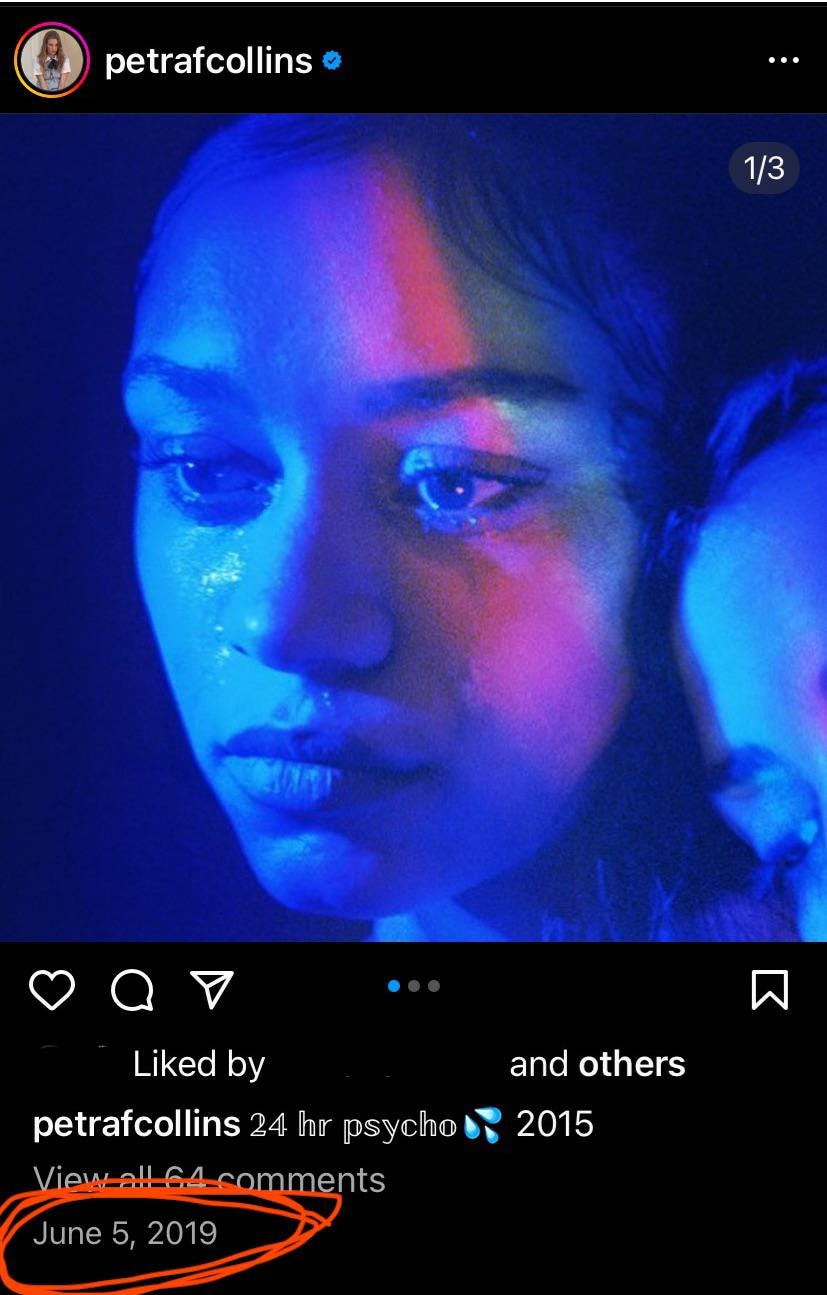
Petra Collins built the entire aesthetic world of the hit series Euphoria but is nowhere in the credits.
The music industry almost criticized Lana Del Rey out of a career.
These may seem like differing events, but for me they both prove the cost of being original.
When I finished the first season of Euphoria, I told everyone I could that it was the most visually stunning show I had ever watched on television. I was so moved, so thoroughly impressed, that I couldn’t bring myself to watch season 2 because I thought no way could this feeling be replicated.
I praised the show’s writer and director, Sam Levinson, for his vision. But it wasn’t until last year that I learned the entire aesthetic and world was created and built by photographer Petra Collins.
This isn’t a controversial statement. Levinson admitted he wrote the show based on Collin’s photography and she worked intimately with Levinson and HBO for five months on everything down to casting. But when HBO told her she was too young to direct and let her go, Collins thought the dream was over but was grateful to HBO for the experience.
Then a year later she saw the billboard of Euphoria.
We’ll come back to this in a minute…
My close friends all know that I’m a massive Lana Del Rey fan. When the video for Video Games dropped, I immediately felt I was witnessing something different, something rare, a creative vision being executed in a way that was specific and uncompromising.
I didn’t realize that I was in the minority.
People don’t remember just how cruel the internet was to Lana when she first came out. They said she couldn’t sing, that she was pretending to be something or someone she wasn’t, that her music promoted a version of femininity that was dangerous.
What both Petra Collins and Lana Del Rey were forced to endure is what I call the cost of being original. Their experiences are different, but the foundation of that experience is, in my mind, exactly the same.

For Petra, what she failed to realize was that the systems in which we plug our creativity into are neutral. They don’t feel, they simply consume. Her vision got consumed by Sam Levinson, consumed by HBO, and now consumed by millions of viewers, most of whom will never know her name.
The cost of Collin’s creativity is not obscurity (she has over a million followers on IG). The true cost of her originality is the loss of legacy, which is actually our loss, the world, for allowing systems that disable our ability to collectively recognize and uplift a visionary who impacted culture in a way few ever have because she didn’t have the resources to fight for her IP.
While some corners of the internet will continue to speak Collin’s name and give her the credit she deserves, as the years pass by and history reflects on the great creative minds of this time period, her name will be pushed to the margins, a footnote when it should be a headline.
Fortunately, we won’t be saying the same about Lana Del Rey, but that almost never happened.
Lana Del Rey’s story has a happier ending, but it doesn’t mean she didn’t pay a price. What she was doing when she first dropped felt so outside of the pop landscape at the time. These were the days of Katy Perry and Lady Gaga and Sia. Pop music existed in its most blatant form, then this sultry storyteller came along with visuals to match the feeling of her music and songs that couldn’t be categorized and the critics (and the industry) didn’t know how to react. And when something so outside of the zeitgeist penetrates the matrix, it reacts like agents protecting itself from what they see as a virus.
The criticism of Lana lasted for years before eventually being named the “Greatest American Songwriter of the 21st Century” by Rolling Stone. This acknowledgement, like most of Lana’s popularity, came relatively recently. After the harsh critique, after the failure to understand her creative vision, after Lana staying true to her original vision of who she is, she finally earned global praise.
And that is something we can take from this.
It’s so easy to create without intention. To write the thing or draw the thing or sing the thing or film the thing and say we are just creating what’s in our hearts, and that should be true. But I don’t think it always is. In fact, in the overwhelming majority of cases, we are creating in a vacuum of our time. What I mean is that too often we are mirrors instead of windows, creating the sum of what we consume subconsciously.
It is rare, and I mean that in the most literal form of the word, that we push ourselves to create something truly original. Originality takes time, it takes purpose, it takes experimenting until we find a perspective that is our own. And then when we find that thing, it takes courage to put it out into the world and say here I am, this is me, this isn’t what is popular or familiar or maybe even comprehensible in this moment but it is the truest expression of my artistry.
As we see, there are consequences to this path.
But as writers, as artists, you need to decide. We all do. My first published novel is a commercial fiction YA book. I love that story so much, but if I’m being completely transparent, I wrote the book I needed to in order to get published. I studied the industry and knew what it wanted and created a story to fit the system. I wasn’t surprised it got published.
Now that I am three books in and proven I can sell a few units, the stories that I’m telling now are the ones that pair my skill and my soul and creative vision most accurately. These are the stories are not meant to fit into any box or comply with any system. These are my originals; the stories I am confident will live forever because I was able to transfer them from my mind to the page without intrusion.
But all of this takes patience. It also takes letting go of outcome, something I struggle with more than anything.
Fefe Dobson, a Canadian musician, was recently interviewed about her career. Fefe was making a brand of alternative music in the late 2000s, early 2010s that, similar to Lana, felt outside the zeitgeist.
Dobson was shunned, but the songs she wrote ended up with the likes of Miley Cyrus and Selena Gomez. The songs the world wasn’t ready to hear from her are now sung by millions, though not in Fefe’s voice. When Dobson was asked about this, she said (and I am not quoting precisely) that she’s happy her songs found a voice and she feels validated, even though she didn’t get to sing those songs herself.
This is the price we can pay for originality. Yes, Fefe Dobson has been (I am assuming) and will be paid well from the royalties those songs will accrue, but I know for a fact most of you have never heard her name. I am equally as sure that you all know Miley and Selena.
I’ll leave you with this: look at your manuscript. I mean really read it over and ask yourself if this is the precise story you want to tell. If there was no goal, no outcome you were chasing, no influence, just you and your creativity, is that still the story you would tell and would you tell it in the manner that is currently on the page?
If the answer is no, then ask yourself if you’re ready to pay the cost of being original.
Great piece! And I love Lana Del Rey! I was really drawn to "Summertime Sadness" when it came out, and I love her range and nostalgic sound. I think being yourself, authentic, original--however you want to look at it--does have great value, regardless of external validation. And I think your challenge is an excellent way to evaluate your work (and maybe even how you are living your life):
"If there was no goal, no outcome you were chasing, no influence, just you and your creativity, is that still the story you would tell and would you tell it in the manner that is currently on the page?"
I have much respect for people who roll on authentic basis and who create intentionally. I subscribed and I hope to support you in your journey. Feel free to check my page and do the same if my content resonates.